Who governs a shared resource?
Rhode Island should govern artificial intelligence the way communities have long governed shared resources: with rules built by the people who depend on them. AI is built from what we hold in common: our data, our language, our creative and civic work. It now touches every issue before the General Assembly, from jobs and health care to housing, schools, privacy, and trust in government.
So far, the state’s AI work has focused on government operations and industry. The public has been surveyed, yet there is room to engage more deeply. In 2026 the Assembly passed three AI healthcare laws, and broader accountability bills are still to come.
AI tools can extend what communities see, analyze, and accomplish. The question is who these systems answer to. This paper answers it with a Nobel laureate’s research, Indigenous wisdom, and with the oldest governance capacity people have: relational intelligence.
What Ostrom found
Communities can govern shared resources well, without privatization or top-down control, when they build the rules themselves. That was the finding of Elinor Ostrom, who in 2009 became the first woman to win the Nobel Prize in Economics, for her analysis of economic governance, especially the commons.
Conventional theory predicted that shared fisheries, forests, and water systems would collapse without a market or a state in charge. Ostrom went into the field and found many that had lasted for generations. The durable ones shared a few conditions:
Trust and reciprocity among the people who depend on the resource
Rules built from within, by the people those rules affect
Monitoring the community itself can see and verify
Accountability to one another, with clear ways to resolve conflict
Carol Anne Hilton, founder of the Indigenomics Institute, makes a related case from Indigenous economic tradition: economies rooted in relationship and responsibility are a source of strength, not a relic. Through Indigenomics AI, she shows that communities can shape AI to serve their own priorities rather than simply adopt it, combining AI, data, and Indigenous knowledge systems toward self-determination.
Relational intelligence: the oldest governance capacity
Relational intelligence is the capacity people use when they weigh hard choices together, and it is what AI governance most needs. It is at work in every town meeting, school board, and kitchen table conversation. It holds that the quality of our relationships sets the quality of our decisions.
We are living through deep confusion between two things: intelligence as a commodity, packaged and sold back to us, and the wisdom that lives in people and communities. Algorithmic systems can generate in seconds what communities once took seasons to develop. They cannot perceive a situation in its full human complexity, hold competing values in tension, or take responsibility for the futures they help bring about. Those capacities require what no algorithm has: a body, a history, a web of relationships, and a stake in the future. Rhode Islanders have all four.
Ostrom’s commons lasted because people used exactly these capacities to build trust and shared rules. The capacity for critical, creative, and conscientious thought is not a soft skill. It is civic infrastructure, and like any infrastructure it needs public investment.
Where Rhode Island Stands
Rhode Island has begun to act. Its 2026 AI laws protect patients and vulnerable users, and broader accountability bills are ready to be taken up again. The state’s privacy law took effect January 1, 2026, with no private right of action and enforcement by the Attorney General alone.
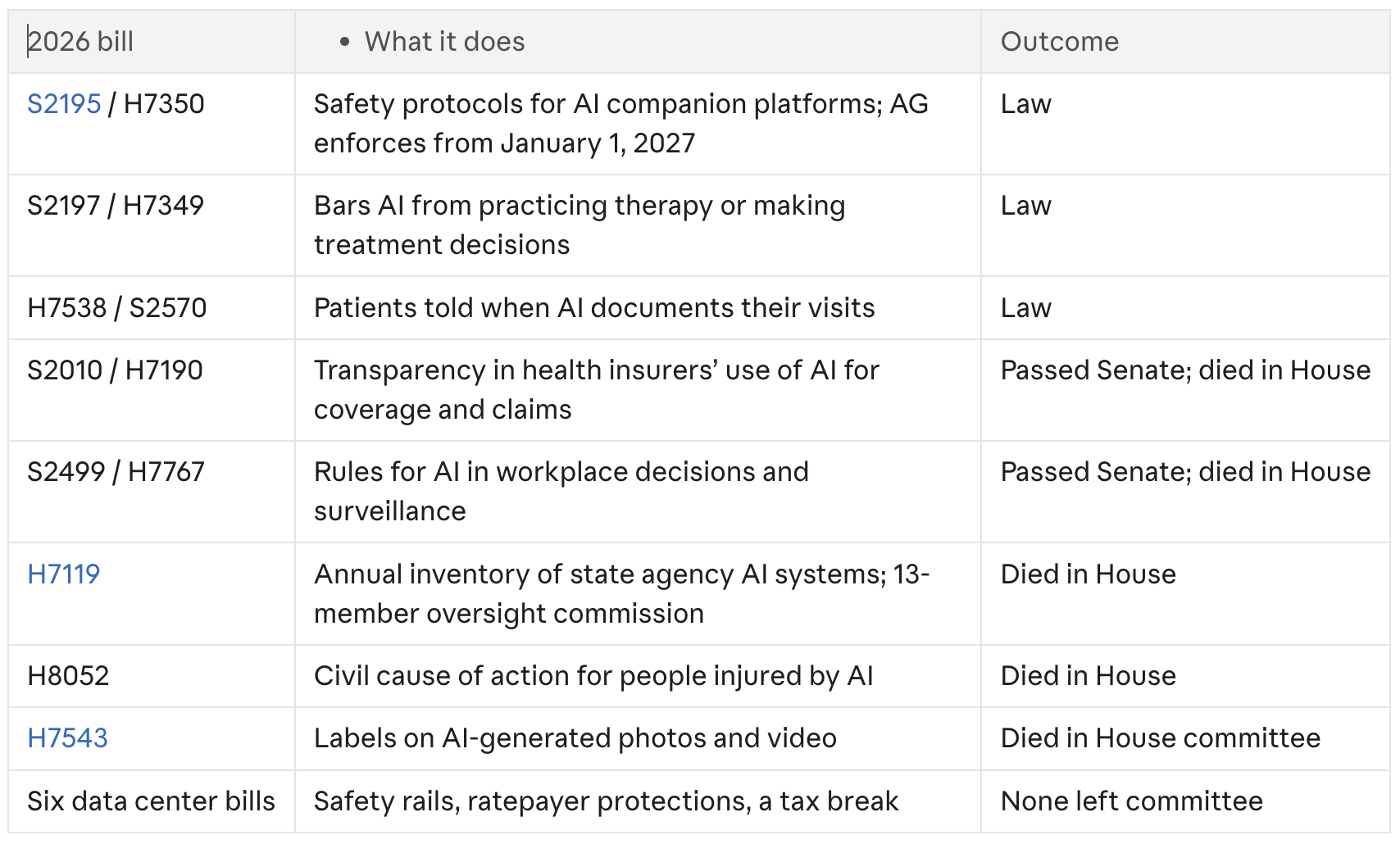
Sources: Route Fifty / Rhode Island Current. Bills are renumbered when reintroduced in the 2027 session.
What the legislature can do
Rhode Island’s task force, legislators, and agencies have laid real groundwork. Ostrom’s conditions offer a way to build on it, and a reminder that how AI enters our lives is a choice, not an inevitability. Each condition points to a concrete step.
Rules built from within. Put the state AI code of ethics called for in Executive Order 24-06 into statute, and require public sessions across the state before it is adopted.
Monitoring the community can see. Pass the agency AI inventory (H7119 in 2026), with a plain-language public report each year.
Participation by those affected. Ask of every AI body and process: who is at the table, and who is not? Convene a representative coalition of the voices most often left out, including workers, young people, elders, rural residents, and the communities with the most at stake, alongside citizen strategists practiced in relational intelligence who can work across the governor’s and attorney general’s offices. Reserve seats for residents on the inventory bill’s 13-member commission, and give host communities a formal voice in data center siting.
Accountability to one another. Pass the workplace AI bill (S2499) and the health insurer bill (S2010), create a path to remedy for people harmed by AI (H8052), and fund the Attorney General to enforce the privacy law and the AI Companion Models Act.
Trust and reciprocity. Fund public AI and relational literacy through libraries, schools, and community organizations, so residents meet these systems with agency rather than dependence.
Self-determination, applied to AI
Governing AI is a question of self-determination, and Rhode Island knows that question well. Roger Williams founded this colony on liberty of conscience, and that inheritance of creativity, innovation, and expressive freedom still defines us. It now means people’s right to decide how they live, how their children are educated, how their data is shared, and whether a data center is built next door.
A commons, properly governed, does not collapse. It seasons. Rhode Island can lead the nation in showing how that works for AI, with its people as partners.
A note on method
The ideas and arguments in this paper come from the author’s own writing: an essay on relational intelligence and letters to Rhode Island’s incoming leaders. Claude, an AI model made by Anthropic, helped shape that writing into a position paper, checked bill numbers and statuses against public records, and suggested edits. The author made every editorial decision.
Using AI this way is part of the practice this paper describes. Asking who is at the table means asking it of our tools too: which voices a system reflects, which it leaves out, and who decides. Each exchange with AI is a small act of governance, and the questions we bring shape what these systems give back.
Sources
Keywords: AI governance, the commons, relational intelligence, Elinor Ostrom, public participation, civic infrastructure, self-determination, accountability, Indigenomics, data privacy, Rhode Island General Assembly, AI ethics